What Is Redis and Why Is It So Fast?
Jun 04, 2026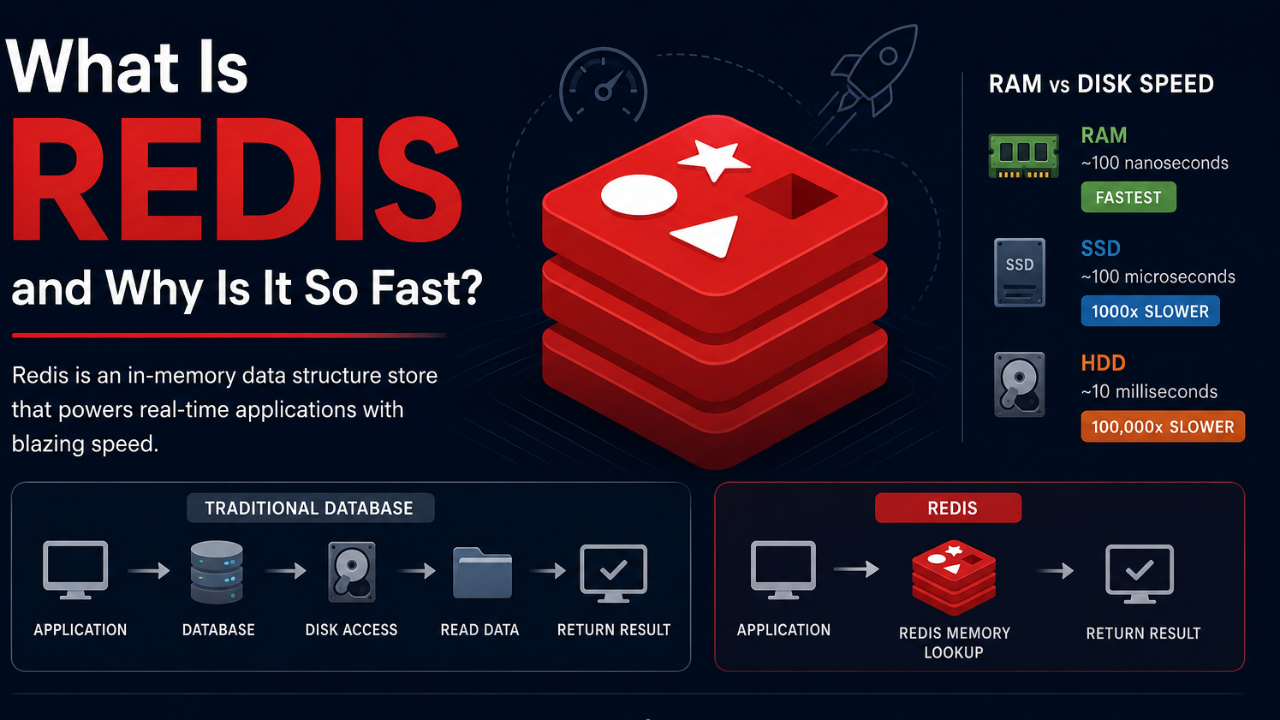
What Is Redis and Why Is It So Fast?
If you've ever worked on a web application that suddenly became slow under heavy traffic, you've likely encountered one of the biggest challenges in software engineering: data access speed.
Modern applications need to serve millions of requests, process real-time updates, manage user sessions, and deliver content instantly. Traditional databases are excellent for persistent storage, but they can become a bottleneck when applications require ultra-low latency.
This is where Redis comes in.
Redis is one of the most popular technologies in modern system design and is used by companies like Netflix, Uber, GitHub, and Stack Overflow to power high-performance applications.
But what exactly is Redis, and why is it so incredibly fast?
Let's break it down.
What Is Redis?
Redis stands for Remote Dictionary Server.
At its core, Redis is an in-memory key-value data store.
Instead of storing data primarily on disk like traditional databases, Redis keeps data in RAM.
For example:
user:123 → John
user:456 → Sarah
Each piece of data is stored as a key and value pair.
When an application needs data, Redis can retrieve it directly from memory rather than performing disk reads.
This simple architectural choice is the primary reason Redis can achieve response times measured in microseconds.
Why Is Redis Fast?
1.Data is Stored in RAM
Let’s understand this with a simple analogy.
Imagine you're looking for a document.
With Traditional Database
The document is stored in a filing cabinet across the room.
You need to:
- Walk to the cabinet
- Open it
- Search for the folder
- Retrieve the document
With Redis
The document is already on your desk.
You simply grab it instantly.
That's essentially the difference between disk storage and memory storage.
That’s why storing data in RAM instead of disk makes Redis very fast.
2. Simple Data Structures
Redis is not designed for complex joins or heavy analytical queries.
Redis performs this operation extremely efficiently since it focuses on highly optimized data structures such as:
- Strings
- Hashes
- Lists
- Sets
- Sorted Sets
- Bitmaps
- Streams
3. Single-Threaded Architecture
This often surprises developers.
Redis processes commands using a single main thread.
At first glance, this sounds slower.
In reality, it removes many common performance issues:
- Thread synchronization
- Lock contention
- Context switching
- Deadlocks
Instead of many threads competing for shared resources, Redis executes commands sequentially at extremely high speed.
The result is predictable performance and lower overhead.
4. Optimized Internal Data Structures
Redis is written in C and heavily optimized.
Its internal implementations are carefully designed to minimize:
- Memory usage
- CPU overhead
- Data copying
Many operations execute in constant time.
5. Efficient Networking
Redis uses a lightweight protocol called RESP (Redis Serialization Protocol).
Commands are tiny and easy to parse.
For example: “GET user:123 “.
The server processes the request with minimal overhead.
Common Redis Use Cases
Redis appears in countless system design interviews because it solves several common scalability problems.
Caching
This is the most popular use case.
Instead of repeatedly querying a database, frequently accessed data is cached in Redis, this dramatically reduces database load.
For example, a product page viewed thousands of times per minute can be cached in Redis rather than hitting the database for every request.
Session Storage
Redis can store session data and retrieve it instantly.
Rate Limiting
Redis counters make implementing rate limiting straightforward.
Real-Time Analytics
Tracking:
- Page views
- Clicks
- Active users
- Live dashboards
Redis can process millions of updates quickly.
Leaderboards
Gaming applications often use Redis Sorted Sets, retrieving the top players becomes extremely efficient.
If Redis Stores Data in Memory, Isn't That Risky?
Memory is volatile.
If a server loses power, memory contents disappear.
Redis addresses this through persistence mechanisms:
RDB Snapshots
Periodically saves data to disk.
AOF (Append Only File)
Logs every write operation.
If Redis restarts, it can replay these commands.
Many production systems use both approaches.
Redis Limitations
Redis is powerful, but it's not a replacement for every database.
Challenges include:
- RAM is more expensive than disk
- Datasets must fit within available memory
- Complex relational queries are not Redis's strength
- Large-scale analytics often belong in specialized systems
A common architecture is: Redis + Database
Redis handles speed.
The database handles durability and complex querying.
Why Redis Matters for System Design
Understanding Redis is essential because it appears everywhere in modern distributed systems.
When applications need:
- Low latency
- High throughput
- Real-time processing
- Scalable caching
Redis is often one of the first technologies engineers reach for.
More importantly, Redis teaches a fundamental system design principle:
Performance often comes from choosing the right data storage strategy, not just adding more servers.
Many scalability problems can be solved simply by moving frequently accessed data closer to the application.
Final Thoughts
Redis is an in-memory data store designed for speed.
By storing data in RAM, using optimized data structures, minimizing overhead, and focusing on simple operations, Redis can process hundreds of thousands—or even millions—of operations per second.
That's why Redis has become a core component of modern architectures, powering everything from caching and session management to real-time analytics and leaderboards.
If you're learning System Design, Redis is one of the most important technologies to understand. Nearly every large-scale application uses caching, and Redis remains the industry standard solution.
Mastering Redis will not only help you build faster applications but also prepare you for system design interviews and real-world architecture challenges.
Want to dive deeper? Enroll in my complete system design course with a launch discount for a limited time: https://thecodingcamp.mykajabi.com/the-complete-system-design-course-crack-senior-faang-interviews
Stay connected with news and updates!
Join our mailing list to receive the latest news and updates from our team.
Don't worry, your information will not be shared.
We hate SPAM. We will never sell your information, for any reason.