What Is Elasticsearch?
Jun 13, 2026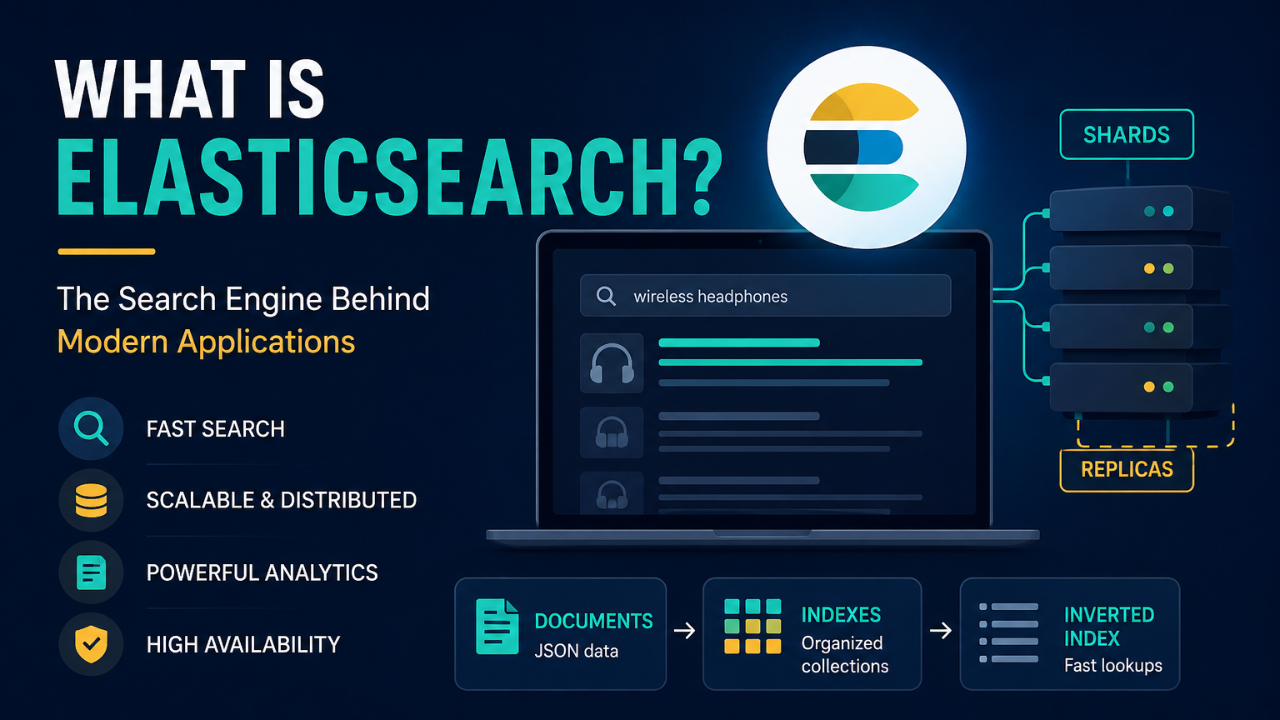
What Is Elasticsearch?
Elasticsearch is a distributed, open-source search and analytics engine built on top of Apache Lucene.
At its core, Elasticsearch is designed to store, search, and analyze large volumes of data in near real time. Instead of scanning entire databases whenever a user performs a search, Elasticsearch creates specialized indexes that allow queries to return results in milliseconds.
Think of it as a highly optimized search engine that can handle everything from website search to log analytics and recommendation systems.
Why Not Just Use a Database?
Traditional relational databases excel at storing and retrieving structured data, but they struggle when it comes to complex search operations.
For example, imagine a user searches for:
"wireless noise cancelling headphones"
A database would need to perform expensive text matching operations across potentially millions of rows.
Elasticsearch, on the other hand:
- Creates inverted indexes for fast lookups
- Supports full-text search
- Handles fuzzy matching and typo tolerance
- Provides relevance scoring
- Scales horizontally across multiple servers
This makes it ideal for search-heavy applications.
How Elasticsearch Works
At a high level, the process looks like this:
1. Documents
Data in Elasticsearch is stored as documents.
A document is typically a JSON object:
{
  "product_id": 123,
  "name": "Wireless Headphones",
  "brand": "Acme",
  "price": 99.99
}
2. Indexes
Documents are grouped into indexes.
You can think of an index as being somewhat similar to a database table, although the underlying implementation is very different.
Examples:
- products
- users
- orders
- logs
3. Inverted Indexes
The secret behind Elasticsearch's speed is the inverted index.
Instead of storing documents and scanning them during searches, Elasticsearch stores a mapping from terms to documents.
For example:
wireless → Doc1, Doc5, Doc8
headphones → Doc1, Doc3, Doc8
noise → Doc1, Doc7
When a user searches for "wireless headphones," Elasticsearch can instantly locate matching documents.
Distributed by Design
One of the reasons Elasticsearch frequently appears in system design discussions is its distributed architecture.
Shards
Indexes are split into smaller pieces called shards.
Instead of storing all data on a single machine:
Index
├── Shard 1
├── Shard 2
├── Shard 3
└── Shard 4
Each shard can live on a different server.
Benefits include:
- Horizontal scaling
- Faster query execution
- Improved fault tolerance
Replicas
Each shard can have replica copies.
If a server fails:
- Replicas continue serving requests
- Data remains available
- Downtime is minimized
This architecture enables Elasticsearch clusters to handle massive workloads while remaining resilient.
Common Use Cases
Website Search
E-commerce platforms use Elasticsearch to power:
- Product search
- Filtering
- Autocomplete
- Recommendations
Log Analytics
Engineering teams use Elasticsearch to search billions of log entries.
Popular observability stacks often combine:
- Elasticsearch
- Logstash
- Kibana
Together, they form the well-known ELK Stack.
Monitoring and Observability
Organizations use Elasticsearch to analyze:
- Application metrics
- Infrastructure events
- Security logs
- Operational dashboards
Content Discovery
Streaming and media platforms use Elasticsearch to help users find:
- Movies
- Music
- Articles
- Videos
Elasticsearch in System Design Interviews
Interviewers often introduce Elasticsearch when discussing systems that require:
- Full-text search
- Large-scale indexing
- Log aggregation
- Analytics platforms
- Content discovery
For example, when designing:
- Amazon Search
- YouTube Search
- LinkedIn Search
- Log Monitoring Systems
Elasticsearch is frequently a strong architectural choice.
However, a good system designer should also understand its trade-offs.
Elasticsearch Trade-Offs
Like any technology, Elasticsearch is not a silver bullet.
Advantages
- Extremely fast search
- Distributed architecture
- Horizontal scalability
- Powerful analytics capabilities
- Rich query support
Challenges
- Additional infrastructure to manage
- Eventual consistency considerations
- Storage overhead for indexes
- Cluster tuning and maintenance complexity
Strong engineers know not only when to use Elasticsearch—but also when not to.
Key System Design Lessons
Elasticsearch teaches several important distributed systems concepts:
- Data partitioning through sharding
- Replication for high availability
- Distributed query execution
- Indexing strategies
- Trade-offs between consistency and performance
These concepts appear repeatedly in system design interviews at companies of all sizes.
Final Thoughts
Elasticsearch has become a cornerstone of modern applications because users expect fast, intelligent search experiences. Its combination of distributed architecture, powerful indexing, and near real-time querying makes it one of the most important technologies for scalable systems.
If you're preparing for system design interviews, understanding Elasticsearch goes far beyond learning a search engine. It helps you understand core distributed systems concepts such as sharding, replication, scalability, and fault tolerance—the same concepts that power many of today's largest applications.
Mastering technologies like Elasticsearch is a key step toward becoming a stronger system designer and building systems that can scale to millions of users.
Stay connected with news and updates!
Join our mailing list to receive the latest news and updates from our team.
Don't worry, your information will not be shared.
We hate SPAM. We will never sell your information, for any reason.