What Is Apache Kafka?
Jun 12, 2026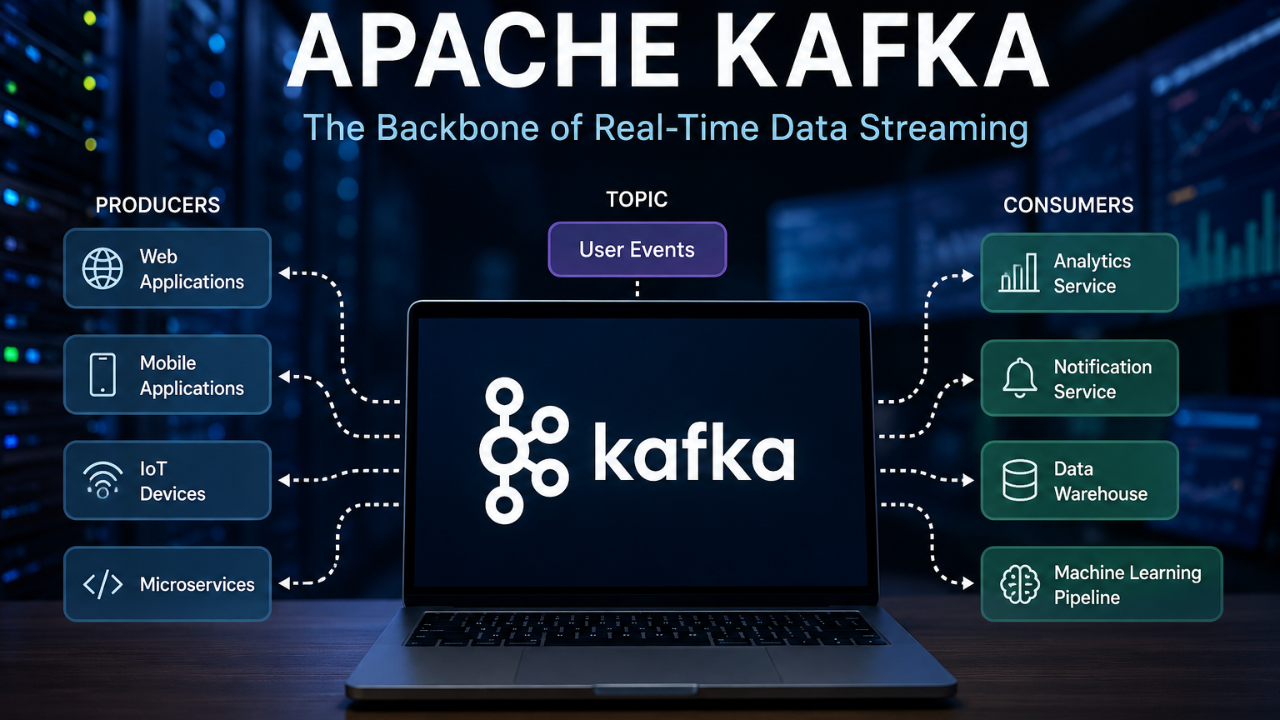
What Is Apache Kafka? A Beginner-Friendly Guide for System Design Interviews
Modern applications generate massive amounts of data every second. User clicks, payment transactions, notifications, analytics events, and logs all need to move between systems quickly and reliably.
This is where Apache Kafka comes in.
Kafka is one of the most important technologies you'll encounter in large-scale distributed systems, making it a common topic in system design interviews and a critical skill for backend engineers.
In this article, we'll explore what Kafka is, why companies use it, and how understanding Kafka can help you become a better system designer.
What Is Kafka?
Apache Kafka is a distributed event streaming platform that allows applications to publish, store, and consume streams of data in real time.
Think of Kafka as a highly scalable messaging system that acts as a bridge between different services.
Instead of services communicating directly with each other, they can send messages to Kafka, and other services can consume those messages whenever they're ready.
This decouples systems and makes large applications easier to scale.
Why Not Just Use APIs?
Imagine an e-commerce application.
When a customer places an order, multiple actions must occur:
-
Process the payment
-
Update inventory
-
Send a confirmation email
-
Generate analytics events
-
Notify the shipping service
Without Kafka, the Order Service may need to call each service directly.
This creates several problems:
-
Increased latency
-
Tight coupling between services
-
Reduced reliability
-
Difficult scaling
With Kafka, the Order Service simply publishes an "Order Created" event.
Other services independently consume the event and perform their tasks.
The Order Service doesn't need to know who is listening.
Core Kafka Concepts
Producer
A producer publishes messages to Kafka.
Examples:
-
Order Service
-
Payment Service
-
Mobile App Backend
Consumer
A consumer reads messages from Kafka.
Examples:
-
Analytics Service
-
Notification Service
-
Recommendation Engine
Topic
A topic is a category of messages.
Examples:
-
orders
-
payments
-
notifications
-
user-events
Producers write to topics, and consumers read from topics.
Partition
Topics are split into partitions.
Partitions allow Kafka to distribute data across multiple servers and process messages in parallel.
This is one of the key reasons Kafka can handle millions of events per second.
Broker
A Kafka broker is a server that stores data and serves client requests.
A Kafka cluster consists of multiple brokers working together.
Why Kafka Is So Popular
Scalability
Kafka can scale horizontally by adding more brokers and partitions.
As traffic grows, capacity can grow with it.
High Throughput
Kafka is designed to process huge volumes of data efficiently.
Large technology companies use Kafka to handle millions of events every second.
Fault Tolerance
Data can be replicated across multiple brokers.
If one broker fails, Kafka can continue operating.
Durability
Messages are stored on disk and can be retained for days, weeks, or even months.
Consumers can replay historical events when needed.
Decoupling Services
Services become independent.
Teams can deploy and scale components without affecting the rest of the system.
Kafka in System Design Interviews
Kafka frequently appears in system design interviews because it solves several common scaling challenges.
Interviewers often expect candidates to introduce Kafka when discussing:
-
Notification systems
-
Activity feeds
-
Analytics pipelines
-
Event-driven architectures
-
Payment processing systems
-
Ride-sharing platforms
-
Social media applications
For example, when designing Uber, a Ride Service can publish ride events to Kafka, while separate services handle billing, notifications, analytics, and fraud detection.
This creates a more scalable and resilient architecture.
Common Kafka Use Cases
Real-Time Analytics
Track user activity and process events as they occur.
Log Aggregation
Collect logs from thousands of servers into a centralized platform.
Event-Driven Architectures
Allow services to communicate through events rather than direct API calls.
Data Pipelines
Move data between databases, applications, and analytics systems.
Stream Processing
Process and transform data continuously in real time.
When Should You Use Kafka?
Kafka is a great choice when:
-
High throughput is required
-
Multiple services consume the same data
-
Reliability is critical
-
Systems need to scale independently
-
Real-time processing is important
However, Kafka introduces operational complexity.
For smaller applications, simpler solutions like message queues may be sufficient.
A good system designer understands both the benefits and trade-offs.
Final Thoughts
Kafka has become a foundational building block of modern distributed systems.
Understanding producers, consumers, topics, partitions, and event-driven architecture will significantly improve your ability to design scalable systems and perform well in system design interviews.
If you're preparing for software engineering interviews or want to become a stronger backend engineer, Kafka is one of the most valuable technologies you can learn.
In our System Design Course, you'll learn not only how Kafka works, but also when to use it, how it fits into real-world architectures, and how to confidently discuss it during system design interviews.
Stay connected with news and updates!
Join our mailing list to receive the latest news and updates from our team.
Don't worry, your information will not be shared.
We hate SPAM. We will never sell your information, for any reason.