Redis vs Memcached
Jun 10, 2026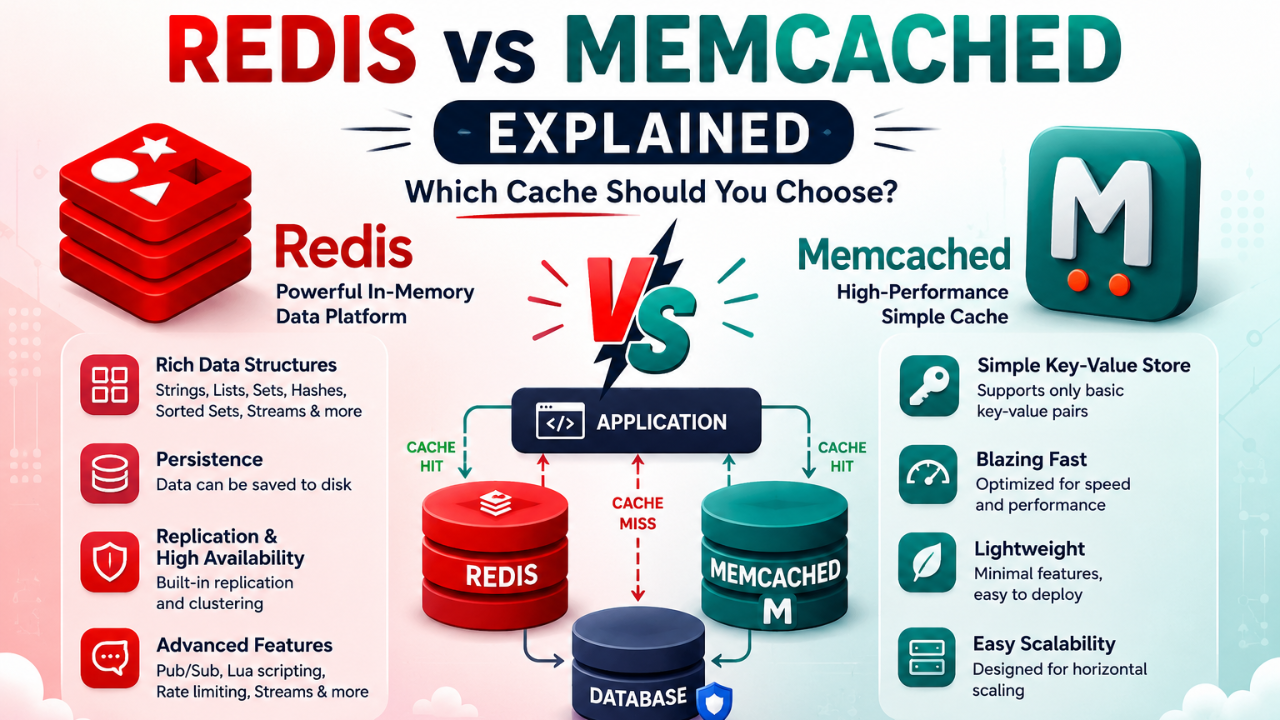
Redis vs Memcached Explained: Which Cache Should You Choose?
When building scalable systems, one of the first performance challenges you'll encounter is database bottlenecks.
As traffic grows, repeatedly querying your database becomes expensive, slow, and can eventually overwhelm your infrastructure. This is where caching comes in.
Two of the most popular caching solutions are Redis and Memcached. Both help reduce database load and improve application performance, but they are designed with different goals in mind.
In this article, we'll explore how Redis and Memcached work, their differences, and when to choose one over the other.
Why Do We Need Caching?
Imagine an e-commerce application receiving thousands of requests every second.
Without caching:
-
Every request hits the database.
-
The database becomes overloaded.
-
Response times increase.
-
Users experience slower page loads.
With caching:
-
Frequently accessed data is stored in memory.
-
Requests are served much faster.
-
Database load decreases significantly.
-
The application scales more efficiently.
Caching is a fundamental concept in System Design interviews and real-world distributed systems.
What Is Memcached?
Memcached is a high-performance, distributed in-memory cache designed specifically for storing key-value pairs.
It is intentionally simple:
-
Stores data entirely in memory
-
Uses a key-value model
-
Extremely fast
-
Easy to deploy and operate
A typical workflow:
-
Application checks Memcached.
-
If data exists, return it immediately.
-
If data is missing (cache miss), query the database.
-
Store the result in Memcached for future requests.
Advantages of Memcached
-
Very lightweight
-
Excellent performance
-
Simple architecture
-
Easy horizontal scaling
Limitations of Memcached
-
Supports only basic key-value storage
-
No persistence
-
No replication
-
Limited data structures
Memcached focuses on doing one thing extremely well: serving cached data quickly.
What Is Redis?
Redis started as a cache but evolved into a powerful in-memory data platform.
Like Memcached, Redis stores data in memory, but it offers many additional capabilities.
Supported data structures include:
-
Strings
-
Lists
-
Sets
-
Sorted Sets
-
Hashes
-
Streams
-
Bitmaps
Redis also supports:
-
Persistence to disk
-
Replication
-
High availability
-
Pub/Sub messaging
-
Distributed locking
-
Rate limiting
-
Leaderboards
This flexibility has made Redis one of the most widely used infrastructure components in modern systems.
Redis vs Memcached
1. Data Structures
Memcached
-
Simple key-value storage
Redis
-
Multiple advanced data structures
Winner: Redis
If your application needs leaderboards, counters, queues, sessions, or rate limiting, Redis provides built-in support.
2. Persistence
Memcached
-
Data disappears when the server restarts
Redis
-
Optional persistence to disk
Winner: Redis
Redis can recover data after failures, making it suitable for more use cases than pure caching.
3. Performance
Both systems are extremely fast.
For simple cache operations:
-
Memcached can be slightly faster
-
Redis performance is often comparable in real-world workloads
Winner: Tie
For most applications, the performance difference is negligible.
4. Memory Efficiency
Memcached
-
Often uses memory more efficiently for simple objects
Redis
-
Additional features create some overhead
Winner: Memcached
When storing massive numbers of simple objects, Memcached may consume less memory.
5. Scalability
Memcached
-
Designed for easy horizontal scaling
Redis
-
Supports clustering and replication
Winner: Tie
Both scale well, though Redis clustering introduces additional complexity.
6. Feature Set
Memcached
-
Pure caching
Redis
-
Caching plus many infrastructure capabilities
Winner: Redis
Many teams use Redis not only as a cache but also for:
-
Session storage
-
Job queues
-
Rate limiting
-
Real-time analytics
-
Messaging systems
When Should You Choose Memcached?
Memcached is a good choice when:
-
You only need caching
-
Simplicity is a priority
-
Memory efficiency is critical
-
You want minimal operational complexity
Example:
A content-heavy website caching rendered pages and database queries.
When Should You Choose Redis?
Redis is a good choice when:
-
You need advanced data structures
-
You require persistence
-
You need replication and high availability
-
You want features beyond caching
Example:
A social media platform implementing:
-
User sessions
-
Feed generation
-
Real-time notifications
-
Rate limiting
-
Leaderboards
What Do Large Companies Use?
Many large-scale systems use Redis extensively because it solves multiple infrastructure problems with a single technology.
Common use cases include:
-
Session management
-
Distributed caching
-
Message queues
-
Real-time analytics
-
Feature flags
-
API rate limiting
Memcached is still widely used, particularly in environments where simple, high-performance caching is all that's needed.
The System Design Interview Perspective
In System Design interviews, interviewers rarely care which technology you memorize.
What they care about is understanding:
-
Why caching is needed
-
What data should be cached
-
Cache invalidation strategies
-
Consistency trade-offs
-
Scaling approaches
-
Failure handling
A strong candidate can explain when Redis is appropriate, when Memcached is sufficient, and the trade-offs involved in both choices.
Final Thoughts
Redis and Memcached are both excellent technologies.
Choose Memcached when you need a lightweight, ultra-fast cache and nothing more.
Choose Redis when you need a cache that can also power queues, leaderboards, sessions, rate limiting, and other distributed system components.
For most modern applications, Redis has become the default choice because of its versatility. However, understanding both technologies—and the trade-offs between them—is an important skill for every software engineer.
Want to dive deeper? Enroll in my complete system design course with a launch discount for a limited time: https://thecodingcamp.mykajabi.com/the-complete-system-design-course-crack-senior-faang-interviews
Stay connected with news and updates!
Join our mailing list to receive the latest news and updates from our team.
Don't worry, your information will not be shared.
We hate SPAM. We will never sell your information, for any reason.