How to Answer Any System Design Interview Question: A Step-by-Step Framework
May 31, 2026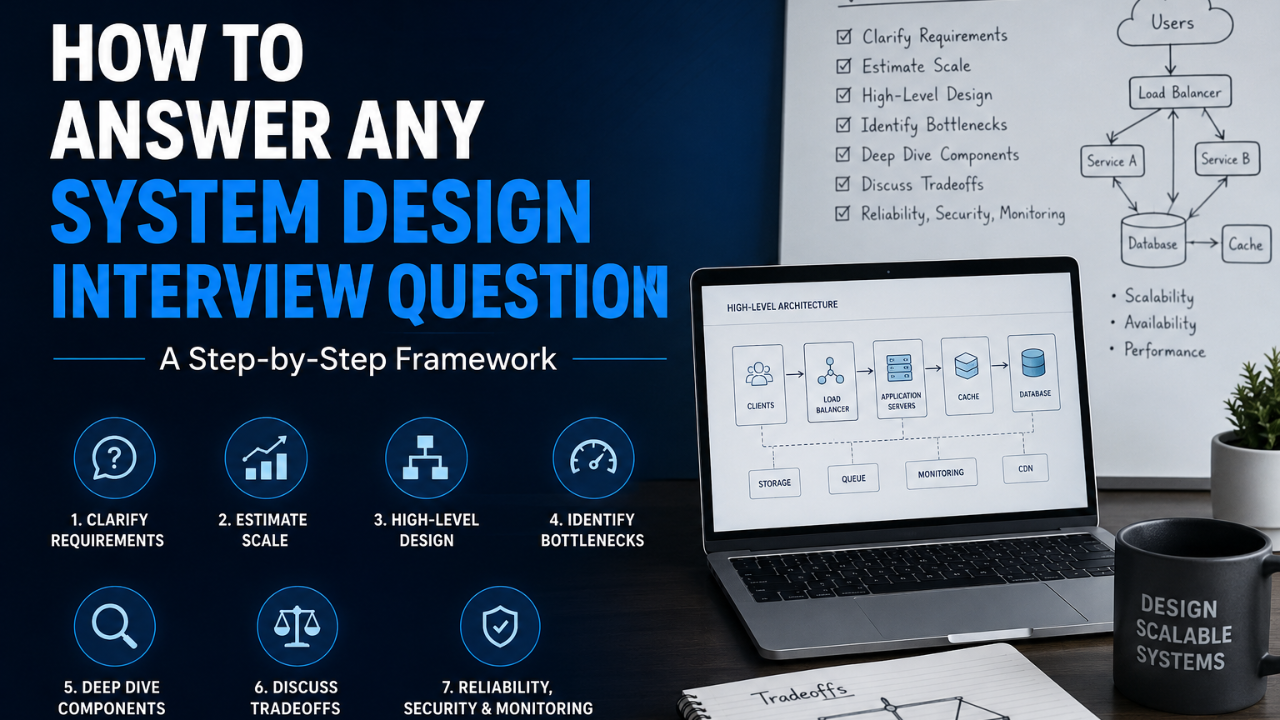
Introduction
System design interviews are often the most intimidating part of the software engineering interview process.
Unlike coding interviews, there is no single correct answer. You're expected to design large-scale systems, make tradeoffs, justify technical decisions, and communicate clearly—all within 30 to 60 minutes.
Many candidates fail not because they lack technical knowledge, but because they approach the interview without a structured framework.
Let's explore a repeatable system for answering any system design interview question successfully.
Why Most Candidates Fail System Design Interviews
Many engineers immediately start drawing databases, APIs, and servers.
This is usually a mistake.
Interviewers aren't primarily evaluating whether you can memorize architectures. They're assessing:
- How you think
- How you communicate
- How you handle ambiguity
- How you evaluate tradeoffs
- Whether you can design scalable systems
Jumping into technical details too early often leads to missing key requirements and designing the wrong solution.
Instead, use a structured framework.
The 7-Step System Design Framework
Step 1: Clarify Requirements
Never begin designing immediately.
Ask questions to understand:
Functional Requirements
What should the system do?
Example for a URL shortener:
- Users can shorten URLs
- Users can access shortened URLs
- Users can create custom aliases
Non-Functional Requirements
How should the system perform?
Examples:
- High availability
- Low latency
- Scalability
- Reliability
- Security
Capacity Estimation
Ask about:
- Daily active users
- Requests per second
- Data storage requirements
- Read/write ratios
Example:
"If we expect 50 million users and 500 million URL redirects per day, scalability becomes a major concern."
Step 2: Estimate Scale
Strong candidates quantify the problem.
Example:
Traffic Estimation
100 million daily requests:
100,000,000 / 86,400 ≈ 1,157 requests per second
Peak traffic (normal traffic * 5):
1,157 × 5 ≈ 5,785 RPS
Storage Estimation
If each record is 500 bytes:
100 million records × 500 bytes = 50 GB
These calculations help justify architectural decisions later.
Step 3: Design a High-Level Architecture
Now create the big-picture design.
At this stage keep the design simple, make sure that it satisfies the functional requirements and don't deep dive into any details yet.
A typical architecture includes:
Clients
- Web applications
- Mobile applications
API Layer
- Load balancers
- Application servers
Data Layer
- Databases
- Cache systems
Supporting Services
- Message queues
- Analytics systems
- Monitoring systems
Step 4: Identify Bottlenecks
Once the basic architecture is complete, ask:
"What breaks first when traffic increases?"
Common bottlenecks include:
Database Overload
Symptoms:
- Slow queries
- High CPU usage
- Connection saturation
Solutions:
- Read replicas
- Sharding
- Caching
Application Server Overload
Solutions:
- Horizontal scaling
- Auto-scaling groups
Network Congestion
Solutions:
- CDN
- Compression
- Edge caching
Interviewers love candidates who proactively identify weaknesses.
Step 5: Deep Dive Into Key Components
This is where senior-level candidates distinguish themselves.
If the interviewer didn't explicitly ask you to deep dive into a specific topic, think about what you have the most experience with and deep dive into it.
Usually it depends on the system you are designing, for example:
For Social Media Systems
Discuss:
- Feed generation
- Fan-out strategies
- Ranking algorithms
For Messaging Systems
Discuss:
- Message delivery guarantees
- Online/offline users
- Ordering
For Video Platforms
Discuss:
- Video storage
- Transcoding
- Content delivery networks
Step 6: Discuss Tradeoffs
This is often the most important step.
Every architecture decision has consequences.
Don't present decisions as universally correct.
Present them as tradeoffs.
Interviewers care more about your reasoning than your final choice.
Step 7: Address Reliability, Security, and Monitoring
Many candidates forget this section entirely.
Strong system designs include:
Reliability
- Redundancy
- Failover mechanisms
- Backups
Security
- Authentication
- Authorization
- Encryption
Monitoring
Track:
- Latency
- Error rates
- Throughput
- Resource utilization
These considerations demonstrate production engineering experience.
Now let's apply the framework on an example question:
Suppose the interviewer asks: Design a URL Shortener like Bitly.
Step 1: Requirements
Functional:
- Create short URLs
- Redirect users
Non-functional:
- High availability
- Low latency
Step 2: Scale
- 100 million redirects/day
- 10 million URL creations/day
Step 3: High-Level Design
Users
↓
Load Balancer
↓
Application Servers
↓
Redis Cache
↓
Database
Step 4: Bottlenecks
Potential issues:
- Database reads
- Redirect latency
Solution:
- Cache popular URLs
Step 5: Deep Dive
Discuss:
- Short code generation
- Collision avoidance
- Expiration handling
Step 6: Tradeoffs
Random IDs vs Sequential IDs
Random:
- Better security
Sequential:
- Simpler implementation
Step 7: Reliability
- Multi-region deployment
- Database replication
- Monitoring dashboards
This structure works for nearly every interview question.
Common Mistakes to Avoid
1. Starting Without Clarification
Never assume requirements.
Always ask questions first.
2. Ignoring Scale
Architectures depend heavily on traffic volume.
A design for 1,000 users differs dramatically from one serving 100 million.
3. Going Too Deep Too Early
Start broad.
Then zoom into critical components.
4. Forgetting Tradeoffs
Avoid statements like:
"MongoDB is better."
Instead say:
"MongoDB offers easier horizontal scaling, while PostgreSQL provides stronger transactional guarantees."
5. Not Communicating Clearly
System design interviews are communication exercises.
Narrate your thought process.
Explain why you're making decisions.
Final Thoughts
The biggest secret about system design interviews is that they're not tests of memorization.
Interviewers aren't looking for the perfect architecture.
They're looking for engineers who can reason through ambiguity, make informed tradeoffs, and communicate effectively.
By following this 7-step framework, you'll be able to approach almost any system design question with confidence and structure.
The more systems you practice using this framework, the more natural the process becomes.
Stay connected with news and updates!
Join our mailing list to receive the latest news and updates from our team.
Don't worry, your information will not be shared.
We hate SPAM. We will never sell your information, for any reason.